
MuT2Go
Pick up your share of MuT (courage) for the future of people and technology - served as brain bites during your lunch break.
MuT2Go (literally: courage to go) is an informative short format on Wednesdays during the TRIANGEL Community Day. Experts from the network of the KIT Center for Man and Technology (MuT) pitch their research perspective on a monthly focus topic, discuss and answer your questions - light-hearted, entertaining, with pop-cultural references.
Everything at a glance
sprungmarken_marker_2565
Socio-Technical Futures of the Smart City: ICT, Urban Transformation, and Power

SaeBom Song is a doctoral candidate in the “Architecture and Intelligent Living” (AIL) research group and a member of the “Cross-Utilizing Knowledge” (CuKnow) Graduate School. At MuT2Go, she will speak about her research topic, “Socio-Technical Futures of the Smart City: ICT, Urban Transformation, and Power.” The presentation will kick off a discussion on the design and planning of cities of the future, to which all participants are cordially invited.
First SaeBom Song studied urban planning at Hanyang University in Seoul after that she began a master’s program in architecture and urban planning in Germany in 2012. She subsequently worked as an urban planner and project manager at architecture and urban planning firms. Since 2023, she has been a doctoral candidate at KIT and a member of CuKnow.
- October 7, 2026, 1:30 – 2:30 p.m.
- TRIANGEL Transfer | Kultur | Raum, Kaiserstraße 93, Karlsruhe**
- Free admission
*Weather permitting, MuT2Go will be held at the MobiLab on Kronenplatz.
This edition of MuT2Go is in German and is perfect for you if you're interested in one or more of the following topics:
- Smart Cities
- Urban Transformation and Technologies
- Society and Participation
- Sustainable Cities
- Urban Planning
The lecture is part of the Real:labor Festival 3.0 Stadt.Gestaltung.Erfahrbar.Machen. and is accompanied by various program highlights, such as hands-on activities, discussions, a movie night, and much more.
The search for a repository for nuclear waste - a school of democracy?

Where to put the nuclear waste? The official site selection process for a final repository in Germany has been underway since 2019. An important milestone will be reached in 2027: a small number of sites will be intensively explored. For the regions affected, there will then be "regional conferences" as an innovative format for public participation.
Behind this is a learning curve for the state and politicians - from the civil war-like resistance to the peaceful use of nuclear energy in Germany to the project of realizing the repository in an exemplary manner - if possible in cooperation with citizens.
Public participation should be "dialog-oriented". The exchange of arguments is intended to improve the quality of the decision in the interests of the "best possible safety". The process can be described as a "school of democracy".
If you are interested in the final disposal of radioactive waste, have questions about the processes or have not yet asked yourself what happens to nuclear waste, you had the chance to find out more. We exchanged ideas with apl. Prof. Dr. Ulrich Smeddinck, Senior Researcher at the Institute for Technology Assessment and Systems Analysis (ITAS) since 2019 and apl. professor at the University of Halle-Wittenberg with a focus on: Environmental and technical law, particular in the area of law governing the search for final repositories, as well as interdisciplinary and transdisciplinary approaches.
This edition of MuT2Go was held in German and was just right for you if you are interested in one or more of the following topics:
- Repository search
- Site conflicts
- Public participation
- Safety issues
- Democratic process
The lecture was part of the Days of Democracy 2026 and was framed by the exhibition "...you tell me - trust in science", which was on display in the MobiLab on June 26 and 27.
Academic freedom is not a law of nature

Why science communication and public engagement strengthen democratic societies
Science is a central foundation of democratic decision-making processes. However, the independence of science cannot be taken for granted – even if it is guaranteed in the German constitution.
From a systems theory perspective, science and politics fulfill different functions: Science seeks evidence-based knowledge, politics organizes majorities and makes socially binding decisions.
Tensions arise where political actors attempt to influence, suppress or distort scientific findings and subordinate them to political objectives. What consequences does this have for science and democracy? And what role can science communication and public engagement play in making the social function of science visible and effective as a basis for political decision-making processes? In this MuT2Go, we will discuss the importance of academic freedom as a cornerstone of modern democracies. Together, we will look at current challenges at the interface between science, politics and society and ask how transparent, dialog-oriented science communication can help to strengthen scientific independence and support evidence-based decision-making processes.
Oliver Häußler provided a special kickoff as a strategy consultant and facilitator for science communication and public engagement at the Center for Media Competence (ZFM) and at the Public Engagement Hub at the University of Tübingen. He prefers to develop and communicate insights in dialog with other people - in a co-creative, participative and practical way.
The MuT2Go invited you to understand science communication and public engagement not only as the transfer of knowledge, but also as a contribution to the stability and sustainability of democratic societies.
It was just right for anyone interested in the following topics:
- Academic freedom and democracy
- Science communication and public engagement
- Science, politics and social negotiation processes
- Evidence-based decision-making
The lecture was part of the Days of Democracy 2026 and was framed by the exhibition "...you tell me - Trust in Science", which was on display at MobiLab on June 26 and 27.
More attention for news about democracy from around the world

How a new platform aims to help better understand complex political developments at an early stage
In Mexico, the government fails in its attempt to change the electoral law. In Burkina Faso, the military dictatorship banned the work of numerous NGOs. And in the Philippines, impeachment proceedings have begun against the Vice President. How much have you heard about these events over the past few weeks? Although we are constantly bombarded with news, on social media as well as on displays on the bus and as online live tickers, our knowledge of current events in the world is not necessarily increasing. As a society, we are "overnewsed but underinformed", and indeed, many of those news topics that we take little to no notice of appear to be very complicated, very granular and very far removed from the reality of our everyday lives. At the same time, researchers in many countries around the world are currently observing a wave of autocratization, which is often taking place in many small steps that go largely unnoticed by the public.
The Deutsche Presse-Agentur (dpa), together with other news agencies, has founded the Democracy News Alliance (DNA), which provides its customers with news and data on autocratization and democratization trends worldwide. An important basis for the selection of topics is a set of scientific indicators developed by the Varieties of Democracy project (V-Dem).
If you wanted to know more about what content DNA disseminates, who it is of particular interest to and what all this has to do with safeguarding democracy, you could talk to Christian Röwekamp, the Editorial Director of DNA.
This edition of MuT2Go was held in German and was just right for you if you are interested in one or more of the following topics:
- Democracy and autocratization
- Media and their use
- The work of news agencies
The lecture was part of the Days of Democracy 2026 and was be framed by the exhibition "...you tell me - trust in science", which was on display at MobiLab on June 26 and 27.
Values in science communication
Science communication on socially relevant scientific or technological issues often finds itself caught between the poles of factual information and normative evaluation. Take, for instance, the ways in which these issues are discussed in the public sphere, whether it's climate change, artificial intelligence, or genetic engineering. Terms such as 'climate justice', 'AI slop' and 'Frankenfood' can clarify social values and their significance in debates about science and technology. However, they also run the risk of delegitimising justified opposing positions prematurely or oversimplifying complex issues.
The research project "Moralizations in science communication" is dedicated to the question of how values can be communicated in connection with scientific issues in such a way that evidence-based compromises can be found and polarization dynamics can be limited.
Have we piqued your interest? You could take the opportunity to exchange ideas with Anna Rifat Klassen. They have a background in philosophy and the history of life sciences and works at the Institute for Technology Assessment and Systems Analysis (ITAS) in the BMFTR-funded project "Moralizations in Science Communication" (MoWiKo).
This edition of MuT2Go was held in German spoken language (with AI-based English simultaneous translation on screens) and was just right for you if you are interested in one or more of the following topics:
- Public debates about science
- Science, technology and values
- Science communication
- Green genetic engineering
The lecture is part of the Days of Democracy 2026 and was framed by the exhibition "...you tell me - trust in science", which was on display at MobiLab on June 26 and 27.
Who is actually deleting whom here?

AI, Hate Speech, and the Question of How Democratic Our Platforms Still Are
When a comment disappears on Instagram, a YouTube video is flagged as problematic, or a complaint on X is automatically responded to, it is increasingly often not a human but an AI system behind it. Such systems evaluate content, decide on visibility, demote posts, or remove them entirely. In doing so, they directly intervene in digital public spheres—and in the question of who is heard, who is protected, and who is silenced.
This issue of MuT2Go focuses on automated moderation, digital violence, and democracy. We begin with a pop-cultural example from meme and platform culture: What happens when irony, hate speech, political criticism, or marginalized self-descriptions must be sorted by machines? A central problem becomes particularly apparent with hate speech and digital violence: AI systems are meant to protect, but at the same time they can create new injustices. Some harmful content remains online, while other posts are wrongly deleted or made invisible.
Dana Mahr presented the new research project AGORA-AI – Automated Moderation and Democratic Public Sphere: Social AI Agents in the Digital Discourse Space, which she is conducting at the Institute for Technology Assessment and Systems Analysis (ITAS) together with Nora Weinberger and Lahari Yaddanapudi. Since June 2026, the project has been investigating how so-called social AI agents are changing public debates on platforms such as Instagram, YouTube, and X. The focus is on questions of responsibility, transparency, fairness, and human control: Who is actually responsible when machines decide what remains visible and what disappears?
The discussion concluded with a positive question for the future: How should digital spaces for discourse be designed so that AI does not simply determine what is visible and permissible, but remains subject to democratic oversight? Instead of just smarter filters, we need transparent rules, effective avenues for complaint, and public oversight of how platforms moderate content. After all, the digital public sphere is not a technical byproduct; it is part of the democratic infrastructure.
This edition of MuT2Go was perfect for you if you’re interested in one or more of the following topics:
- Artificial Intelligence and Democracy
- Digital Violence and Hate Speech
- Social media and public debates
- Platform regulation
- Visibility, moderation, and responsibility
The lecture was part of the Days of Democracy 2026 and was framed by the exhibition "...you tell me - trust in science", which was on display at MobiLab on June 26 and 27.
MuT2Go – Community Schnack
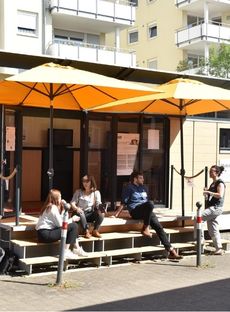
Democracy needs MuT (Courage). What role should academia play in democracy? How can universities contribute to democracy?
We’d love to hear your ideas. Feel free to stop by and share your thoughts!
- Sunday, June 28, 2026, 1:30–2:30 p.m.
- at MobiLab on Kronenplatz in Karlsruhe
- Free admission
Medicine of the future - tailored to you

Every year, millions of people hope for successful rehabilitation therapy. It is crucial for restoring the quality of life and ability to work of patients with cardiovascular diseases and chronic pain in the long term. In view of demographic change, precise rehabilitation is becoming increasingly important. The INNOVARE research project is working on using AI to bring personalized rehabilitation medicine from a futuristic vision to the reality of the present.
The aim is to switch from standard treatment plans to tailor-made treatment models. Based on biometric data, AI-supported systems could generate therapy suggestions tailored to the individual patient. In this way, the potential of each therapy could be better realized to significantly improve physical and mental health.
It was possible to meet Mailah Khan from the "Health Education and Sports Psychology" research group, at the next MuT2Go and to learn all about pioneering AI therapy approaches and how to get the most out of your personal rehab program.
This edition of MuT2Go was just right for you if you are interested in one or more of the following topics
- Medicine of the future
- Artificial intelligence
- Health topics
- Data topics
Why crises in soccer are no coincidence
In professional soccer, the moment often seems to come abruptly: The results fail to materialize, the mood changes, the coach feels under pressure. What publicly appears to be a sudden collapse is, on closer inspection, the result of a longer, previously hidden process.
KIT researchers led by MuT spokesperson Prof. Dr. Darko Jekauc show that performance crises are not only decided on the pitch - but in the interplay of expectations, results and psychological dynamics(click here for the paper). Although vast amounts of performance data are available in professional soccer, the mental processes behind instability and self-doubt have so far remained elusive. This is precisely where the new mathematical approach of the "Sporting crises in professional soccer" project of the "Health Education and Sport Psychology" group comes in.
You were able to talk to Prof. Dr. Darko Jekauc, head of the "Health Education and Sport Psychology" research group, about crises in professional soccer and find out what role the number Phi plays and how his approaches can be transferred to other systems in which expectations, dynamics and collective processes interact.
This edition of MuT2Go took place on February 11th and was perfect for you if you are interested in one or more of the following topics:
- Dark side of professional soccer
- Sports science
- Psychological approaches in sport
- Team crises
You can find out more about the topic in advance here.

Not everyone is in hibernation
The BioBlitz Karlsruhe - Artificial intelligence, data and species knowledge
Dr. Judith Bieberich, Project Manager"Species Knowledge for All" at the State Museum of Natural History , introduced the BioBlitz-Karlsruhe and gave an overview of the wild animal, fungi and plant species that you can observe in Karlsruhe.
The MuT2Go took place as part of the BioBlitz Advent calendar.
This edition was just right for you if you are interested in one or more of the following topics:
- Fungi, animal and plant species in Karlsruhe
- Research at the Natural History Museum
- Citizen science and species knowledge
- Opportunities and challenges of artificial intelligence for species knowledge
- Data quality vs. quantity
My digital twin
Digital patient twins and gender / sex biases

What are digital twins and what benefits do they have in the medical treatment of patients? Do they help all patients to the same extent? What role does data play?
Portrait of Dr. Dana Mahr in front of a turquoise background. scientist Dr. Dana Mahr (ITAS, KIT) talked to you about justice and the use of digital patient twins.
This edition of MuT2Go was just right for you if you are interested in one or more of the following topics:
- Gender justice
- Medicine and medical ethics
- Digital Twins
- Artificial intelligence
- Animes (why, that will be solved on Wednesday) :)
Your feed, your democracy
The brand new MuT2Go format was launched as part of the Days of Democracy with the pilot edition "Your Feed, Your Democracy" with Prof. Dr. Christof Weinhardt on September 17, 2025.